Resources

Understanding interRAI Assessments & Appealing Level of Care Decisions
Indiana has transitioned to the interRAI suite of assessment tools to determine Level of Care (LOC) eligibility for Medicaid Home and Community-Based Services (HCBS) waivers. This page explains what the change means for individuals and families and provides clear steps if a Level of Care determination is denied.
What is interRAI?
interRAI is a standardized, research-based assessment system developed by an international non-profit collaborative. Indiana’s Bureau of Disabilities Services (BDS) now uses it to determine Intermediate Care Facility / Intellectual Disability (ICF/IID) Level of Care for the Family Supports Waiver (FSW) and Community Integration and Habilitation (CIH) Waiver. It replaces the previous Level of Care Screening Instrument (LOCSI).
Age-specific tools:
- interRAI Early Years – ages 0–3
- interRAI Child and Youth Mental Health and Developmental Disability (ChYMH-DD) – ages 4–17
- interRAI Intellectual Disabilities (ID) – ages 18+
These assessments capture functional, behavioral, medical, and psychosocial needs. They rely on observation, collateral input, and documentation rather than opinion.
Core principles that matter most:
- Answers must reflect usual performance, not best days.
- If a person requires prompting, cueing, hands-on assistance, or supervision, they are not independent.
- Assessors must consider what would happen without staff or caregiver support.
- Responses cover a designated look-back period (typically 7–30 days).
Accurate interRAI information directly affects eligibility, service planning, authorization, funding, and individual safety.
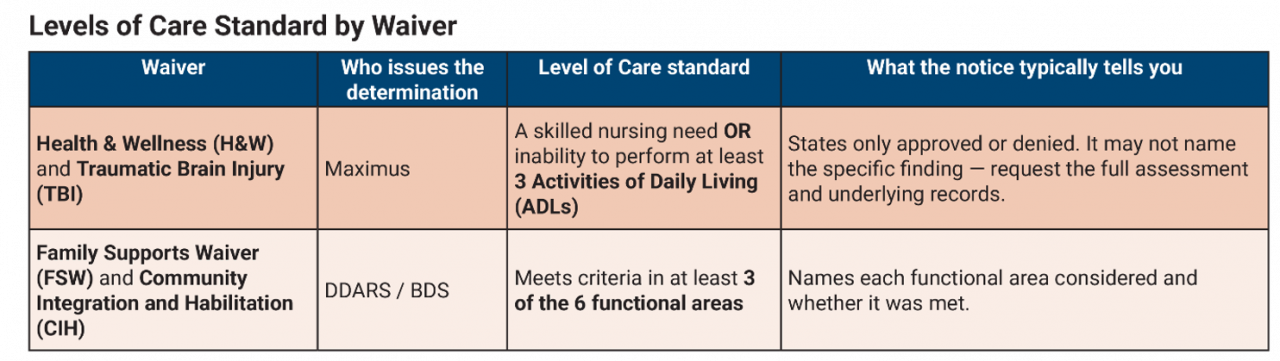
The six functional areas (FSW / CIH):
- Mobility
- Understanding and use of language
- Self-care
- Capacity for independent living
- Learning
- Self-direction
Important note: Some older determination letters still list “economic self-sufficiency.” This criterion is no longer used in determining Level of Care eligibility.
Appealing a Level of Care Denial
You have 33 days from the date on the decision letter to request an appeal.
File first — gather evidence afterward. Filing preserves the appeal right. Individuals already receiving waiver services generally keep those services during a timely appeal (follow the continuation-of-benefits instructions in the notice exactly).
The Five Steps
1. Review the Decision
Identify the waiver and the applicable standard. Read every finding, not just the bottom line. Mark the specific finding(s) that do not accurately reflect the person’s actual functioning and support needs. A narrow, well-supported challenge to one incorrect finding is stronger than a broad challenge.
2. Request the Appeal
Use the enclosed form or a written request. Name the disputed finding and briefly explain why. Attach a copy of the decision. Designate an authorized representative if the individual chooses one. Ask for the complete LOC assessment and all records used in the determination. Submit by a method that documents the date (mail confirmation, fax receipt, or stamped “Received” at a BDS office) and keep copies.
3. Gather Evidence
Focus only on current records and firsthand statements that speak to the disputed finding. Describe prompting, supervision, physical assistance, adaptive equipment, and significantly added time.
Test every document with this question: “Which Level of Care finding does this explain or dispute?”
Do not exaggerate limitations. Do not minimize the support the person ordinarily needs.
4. Build the Packet
After the appeal is filed, you will receive a Notice of Telephone Hearing from the Office of Administrative Law Proceedings (OALP). Note the hearing date, evidence deadline, and where to send materials. A typical packet includes:
- Summary of Facts
- Position Statement
- Witness List
- Labeled, page-numbered exhibits
Serve the packet on both OALP and the state’s representative by the deadline. Keep a complete copy.
5. The Hearing
Hearings are usually conducted by telephone. A pre-hearing conference may resolve the issues. The state presents first; you may question its witnesses. Point the Administrative Law Judge to specific exhibits and summarize the disputed finding.
Do not withdraw an appeal solely because a new assessment is offered unless the original issue has been fully resolved. The decision belongs to the individual or their authorized representative.
After the Hearing
- The Administrative Law Judge issues a written decision later.
- Agency Review looks only at the existing hearing record — no new evidence is allowed.
- Judicial review may be available afterward; consider consulting an attorney at that stage.
Action Checklist
Within the 33 days
- Identify the waiver and the LOC standard that applies
- Calculate and log the due date
- Mark the specific finding(s) that are inaccurate
- Notify the family of the denial, the right to appeal, and the deadline
- File the appeal naming the disputed finding and attach the decision
- Request continuation of benefits per the notice’s instructions
- Request the complete LOC assessment and all records used
- Submit with dated proof of sending and keep a full copy
After filing
- Pull internal documentation (ISP/PCISP, incident reports, DSP notes, behavior/safety plans, therapy notes, medication records)
- Request current external records and specific written statements
- Confirm releases are in place before sharing protected health information
- Line up witnesses with firsthand knowledge
- Screen every document against the disputed finding
- Log the hearing date, evidence deadline, and service addresses
- Draft the Summary of Facts and Position Statement
- Label and number exhibits; finalize the Witness List
- Serve OALP and the state by the deadline; keep a complete copy
Our Role and Important Boundaries
The decision whether to appeal, how to proceed, and whether to withdraw belongs to the individual or their authorized representative — not to Easterseals Community Network.
Our role is to inform, document accurately, supply records and firsthand observation, and connect families to advocacy or legal help when needed. Everything we provide must be accurate and truthful. We describe the support the person actually needs — neither exaggerated nor minimized.
Helpful Resources
From The Arc of Indiana (recommended first stop for families)
- Appealing an HCBS Level of Care Determination – Detailed Guide
- Appealing an HCBS Level of Care Determination – Quick Guide
- Appealing a Level of Care Denial Webinar (Part 1 & Part 2) + Slides
- Medicaid & Medicaid Waiver Updates
State & Official Resources
- Indiana Medicaid Benefits Portal: fssabenefits.in.gov
- BDS Gateway (FSW applications): bddsgateway.fssa.in.gov
- Maximus LCAR Help Desk (H&W / TBI assessments): 1-833-597-2777
- Local Bureau of Disabilities Services (BDS) office
This page provides general information only. It is not legal advice. Always follow the specific instructions, forms, and deadlines on your own determination letter and notices from Maximus, DDARS/BDS, or the Office of Administrative Law Proceedings.